



Restore confidence and function with dentures
Full and partial dentures provide a practical way to replace missing teeth, helping restore your smile and support everyday speaking and chewing.
Restore confidence and function with dentures
Full and partial dentures provide a practical way to replace missing teeth, helping restore your smile and support everyday speaking and chewing.
Restore the function of your jaw and improve the appearance of your smile.
When you lose several teeth, it doesn’t just impact your self-confidence, but also your health and facial structure.
Dentures are a fantastic treatment option for those who have lost teeth, offering a gorgeous smile and fully functional teeth.


Implant retained denture
What are dentures?
Dentures, also known as false teeth, are used to fill in the gaps created by missing teeth. They restore your smile, as well as your bite, and will also maintain your facial structure, as missing teeth can cause facial muscles to sag over time.
Missing teeth are more common among adults and elderly people, and can be caused by several issues such as decay, periodontal disease, poor oral hygiene, or accidents.
Your dentist will begin with an examination and talk you through the best options for dentures specific to your smile. There are a few different ways to ‘do’ dentures, and it will depend on your oral health and goals as to which is best for you. Types of dentures:
Full Denture
Partial Denture

Full Dentures
Where all your teeth have been lost, the provision of plastic upper and lower dentures is the norm, and we are happy to provide this service. Even when all due care is taken, many patients experience problems with stability and retention, particularly with the lower denture, which does not generate suction like the upper denture often can, and it also has to cope with the movement of the tongue during speech and when chewing. Many people simply adapt to these shortcomings, but they can be greatly reduced by the provision of dental implants.

Partial Dentures
Where some of your teeth remain, the spaces can be filled with a partial denture. This is the most inexpensive way of coping with the problem. However they suffer to a greater or lesser extent from the same drawbacks as full dentures. In addition, a partial denture will rub around the necks of the remaining teeth compromising healthy gums. Food packing between teeth and dentures can also be an issue. The cheapest partial dentures are made of plastic. Lessening of the problems can however be achieved with the greater accuracy in fabrication provided by a metal casting to provide the framework. Avoiding the problems of partial dentures can be achieved by looking at the ‘fixed’ solutions provided by bridges or implants.
How do dentures work?
Conventional dentures
Conventional dentures are custom-made after the teeth have been removed to ensure the perfect fit. They are typically placed 8-12 weeks after the teeth have been removed, with the benefit of them fitting well straight away.
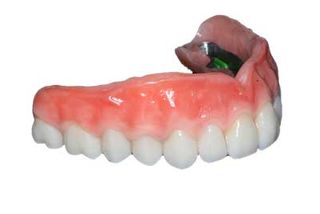
Immediate dentures
Immediate dentures are made and placed immediately after your teeth are removed. The benefit here is that you don’t spend any time without teeth, however, the downside is that they will need to be adjusted and refitted regularly as your gums heal and change shape in the months following your teeth removal.

Dentures take time and preparation to get in place, but the massive benefits to your health and confidence are worth every second. If you are missing multiple teeth or need to have multiple teeth extracted due to disease or decay, your dentist will talk to you about the benefits of dentures. Dentures are metal, acrylic, or made from a plate designed to fit over the bone and soft tissues of your jaw. Ceramic or acrylic false teeth are attached to the plate, matching any remaining teeth to create a natural look.
Depending on whether you get conventional or immediate, and full or partial, your exact treatment plan timeline will look a little different. However, once they are placed and fitted, there will be an adjustment period as you get used to wearing them while speaking, eating, and drinking.’
Are dentures the right treatment for me?
Dentures are a great treatment for many people who have lost several, or all of their teeth. They will replace your natural smile and confidence and maintain your cheek muscles and facial structure (which can be affected by missing teeth over time).
If you’re concerned about whether dentures are right for you, or would like to learn about other options, speak to your dentist. They are best equipped to assess your oral health and offer treatment plans that will help you rediscover your health, smile, and confidence.
Advantages of dentures
Dentures are a popular option for those needing teeth replacement, as they offer several fantastic advantages:
What to expect from your dentures appointment
Each denture treatment will vary depending on your circumstances, but here is the general process if you are receiving full dentures. For more information on the process for getting dentures and what approach is best for you, get in touch with our friendly team.
1. Following tooth extraction, your dentist will place immediate dentures onto your gums so you have teeth during the healing process.
2. Once your gums have healed and settled, your dentist will take impressions to have custom dentures made for your mouth
3. Immediate dentures will typically fit well but not perfectly and will need readjustment as your gums heal over the coming weeks and months
4. The custom dentures will take a few weeks to create
5. You will return to your dentist to have the conventional dentures put in place, and your dentist will work to make sure they are fitted well and will not cause rubbing.
6. You will have an adjustment period where you get used to wearing dentures day and night as you eat, drink, talk, and sleep.
7. You may return to your dentist during this time to have the dentures adjusted further for a better fit.
8. Over time, your dentist will keep an eye on the health of your gums and the condition of your dentures, and you will need to maintain good oral hygiene to take care of both.
Frequently Asked Questions
The cost of dentures depends on several factors. Apart from insurance coverage and the level of customisation, this price varies greatly depending on how it's made.
Give our friendly team a call today for more information.
Yes, absolutely! Partial dentures will restore full functionality to your mouth, so you will be able to eat and drink normally. There will be an adjustment period where you get used to your dentures, but they will soon become the norm.
The best dentures to get depend on your specific situation. If you have lost all of your teeth, you will likely be best getting a full set of dentures, and your dentist may recommend having an immediate set placed, followed by a conventional set.
If you have lost several teeth but still have some healthy teeth, your dentist may recommend a partial set of dentures. However if you have lost your teeth to periodontal disease or another issue that may affect the rest of your teeth, your dentist may suggest extracting your remaining teeth that are unlikely to last, and getting a full set of dentures.
It all depends on your current and likely future oral health, so your dentist will be the best person to guide you through the options.
Yes, it is possible to get immediate dentures in one day. However, immediate dentures are not custom-made for your mouth, which means that they won’t typically fit as well and will need multiple adjustments.
Immediate dentures are typically used as a short-term solution while you wait to get conventional dentures, which are custom-made for your mouth.
Partial dentures typically last between 10 and 15 years with good care. This means cleaning them, looking after your gums, eating a healthy diet, and attending regular dental visits.
However over time, dentures can wear down, and the shape of your mouth and gums can change enough that you will need to have your partial denture replaced.
Regular appointments with your dentist will help you keep an eye on the situation and keep you informed about how well the denture is lasting.
We would be happy to carry out an assessment for improvements that may be possible to your dentures, and to explain options for stabilisation of your dentures with the use of dental implants.